


Description
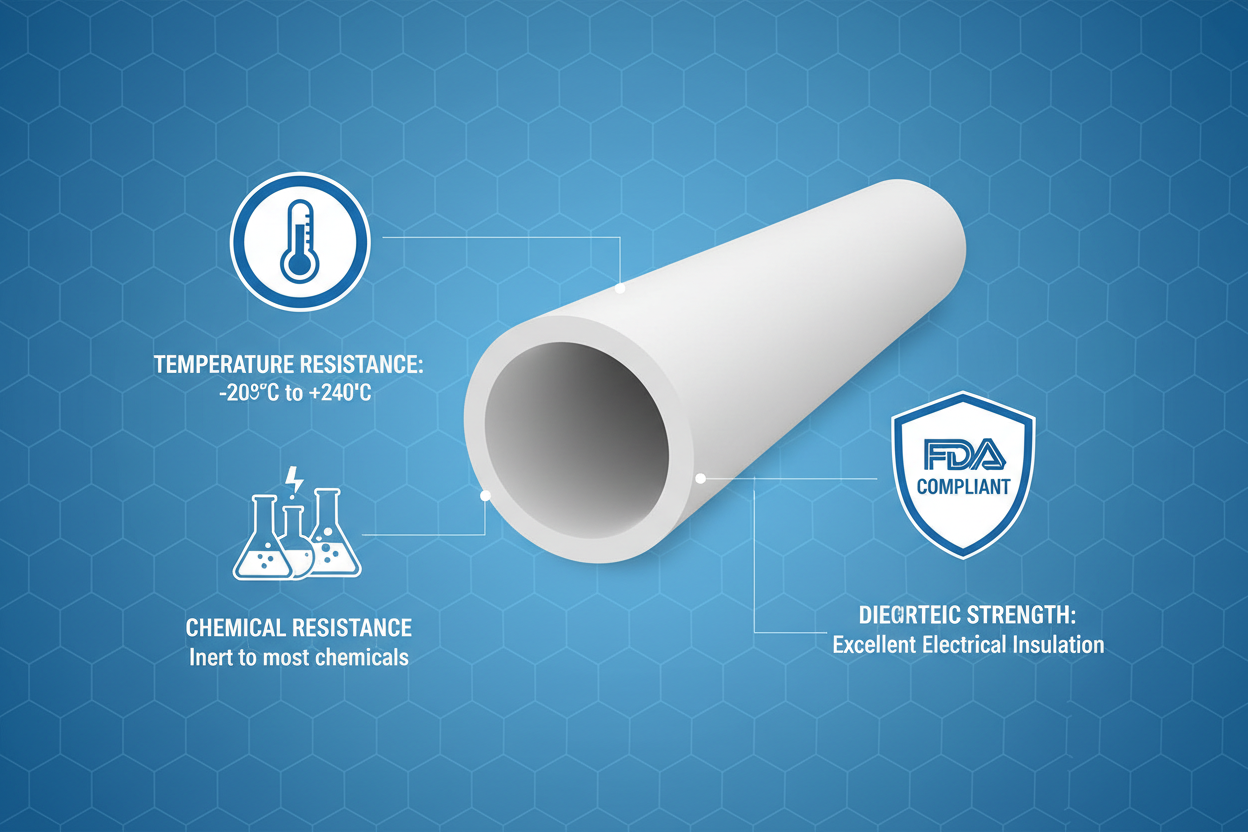
Virgin PTFE tube from 10 mm to 45 mm OD: 47 OD × ID combinations, supplied in 2000 mm lengths. PTFE (polytetrafluoroethylene, often known by the brand name Teflon®) is the most chemically inert engineering plastic available. It resists almost every industrial chemical and solvent, works from cryogenic temperatures up to +260 °C, has the lowest friction of any solid plastic and is an outstanding electrical insulator. These thick-walled tubes are ideal for machining small bushes, sleeves, spacers and insulators, and for chemical-resistant fluid and gas lines.
At a Glance
- Material: 100% virgin (unfilled) PTFE, white
- Outside diameters: 10, 12, 14, 15, 16, 18, 20, 22, 25, 27, 30, 33, 35, 38, 40 and 45 mm
- Wall thickness: from 2 mm to 15 mm
- Length: 2000 mm. Cut-to-length and bulk quantities available on request
- Service temperature: −200 °C to +260 °C continuous
- Chemical resistance: resists virtually all acids, alkalis and solvents
- Friction: coefficient 0.05–0.10, the lowest of any solid plastic
- Electrical: excellent dielectric strength, very low dielectric loss
- Flammability: UL94 V-0, self-extinguishing
Available Sizes
Choose a thick wall when you need material to machine shoulders, grooves or threads, or for higher-pressure lines. Choose a thin wall for sleeves, liners and lightweight parts.
| OD | Available IDs | Wall range |
|---|---|---|
| 10 mm | 6 mm | 2 mm |
| 12 mm | 6, 8 mm | 2–3 mm |
| 14 mm | 6, 8 mm | 3–4 mm |
| 15 mm | 8, 10 mm | 2.5–3.5 mm |
| 16 mm | 6, 8, 10, 12 mm | 2–5 mm |
| 18 mm | 8, 10, 12 mm | 3–5 mm |
| 20 mm | 6, 10, 12 mm | 4–7 mm |
| 22 mm | 8, 10, 12, 15 mm | 3.5–7 mm |
| 25 mm | 10, 12, 15, 20 mm | 2.5–7.5 mm |
| 27 mm | 12, 15, 18, 20 mm | 3.5–7.5 mm |
| 30 mm | 10, 12, 15, 18, 20 mm | 5–10 mm |
| 33 mm | 18 mm | 7.5 mm |
| 35 mm | 15, 20, 25 mm | 5–10 mm |
| 38 mm | 22 mm | 8 mm |
| 40 mm | 20, 25, 30 mm | 5–10 mm |
| 45 mm | 15, 20, 25, 30, 35 mm | 5–15 mm |
Weight guide: weight per 2000 mm length (kg) ≈ (OD² − ID²) × 0.0034, with OD and ID in mm. For example, 10 × 6 mm ≈ 0.22 kg, 25 × 10 mm ≈ 1.8 kg and 45 × 20 mm ≈ 5.5 kg. The exact shipping weight for each size is shown at checkout.
Technical Data (Typical Values for Virgin PTFE)
| Property | Typical value |
|---|---|
| Density | 2.14–2.20 g/cm³ |
| Tensile strength | 20–35 MPa |
| Elongation at break | ≥ 200% |
| Hardness | Shore D 50–60 |
| Continuous service temperature | −200 °C to +260 °C |
| Melting point | ≈ 327 °C |
| Coefficient of friction (dynamic) | 0.05–0.10 |
| Water absorption | < 0.01% |
| Coefficient of thermal expansion | ≈ 100–160 × 10⁻⁶ /K |
| Dielectric constant (1 MHz) | ≈ 2.1 |
| Volume resistivity | > 10¹⁷ Ω·cm |
| Flammability | UL94 V-0 |
| UV / weathering resistance | Excellent |
These are typical material values, not guaranteed minimums. Ask us for the material data sheet if your application needs certified figures.
Why Choose PTFE Tube?
- Chemically inert: unaffected by strong acids, alkalis, oxidisers and organic solvents. The only known exceptions are molten alkali metals and elemental fluorine at high temperature.
- Self-lubricating: runs dry against metal with very low friction and no stick-slip, so bushes and guides need no grease.
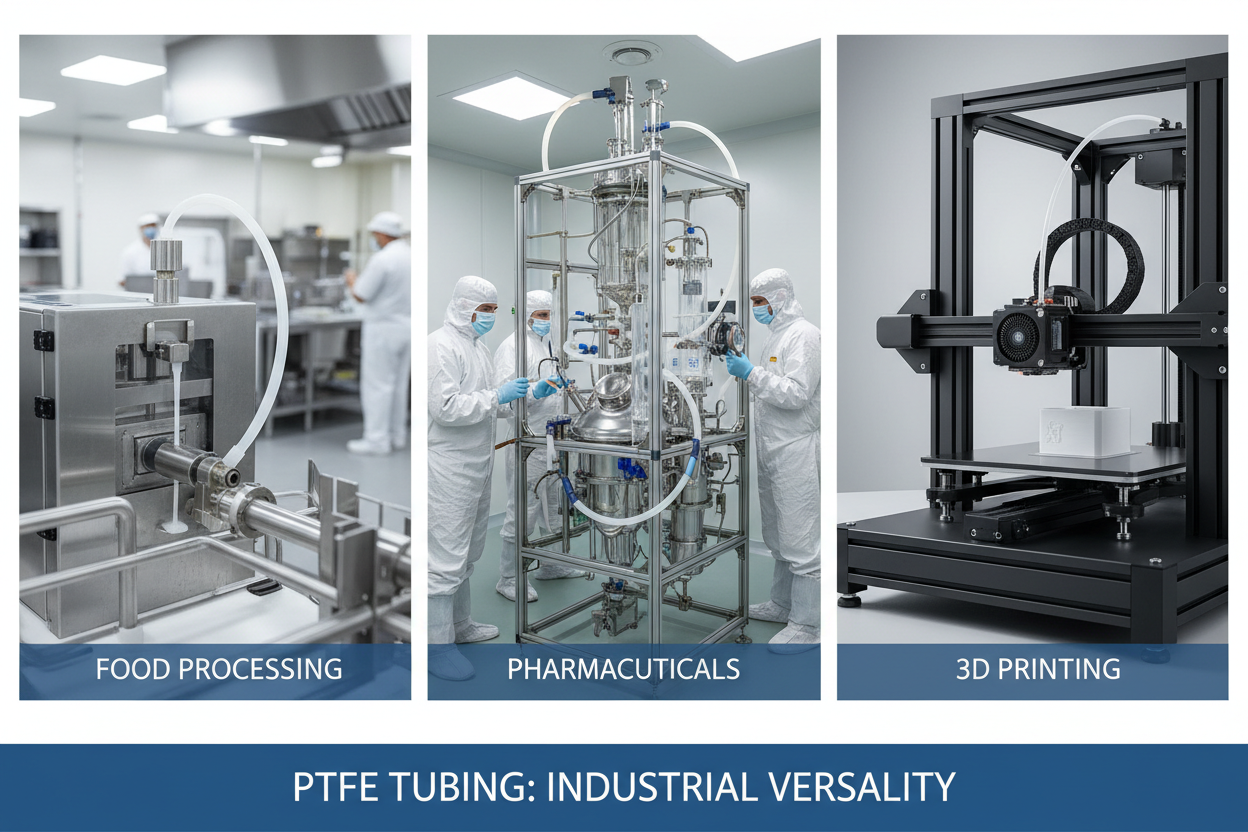
- Non-stick and hygienic: almost nothing adheres to it, so it cleans easily in labs, food processing and pharmaceutical settings.
- Stable at temperature: keeps its properties from cryogenic service up to +260 °C, where most plastics soften or embrittle.
- Superior insulator: very high dielectric strength and resistivity with near-zero moisture uptake, so electrical properties stay consistent in damp conditions.
- Easy to machine: turns, bores and drills cleanly on standard equipment.
Typical Applications
- Laboratory and chemical: transfer lines, sample tubes, reaction vessel fittings
- Mechanical engineering: small plain bearings, bushes, spacers and guide sleeves
- Electrical: insulating sleeves, stand-offs, cable and terminal spacers
- Food and pharmaceutical: non-stick guides, nozzles and sealing components
- 3D printing and machinery: low-friction filament and wire guides
- Semiconductor and cleanroom: high-purity fluid-handling parts
Machining Tips
- Use sharp, positive-rake HSS or carbide tooling with light cuts and good chip clearance.
- PTFE expands about 10× more than steel with temperature. Measure finished parts at about 23 °C, and allow for operating temperature when setting fits and clearances.
- Support thin-wall sizes on a mandrel or in soft jaws to avoid distortion while clamping.
- PTFE can creep under sustained load. For high-load bearings, keep contact pressures moderate or ask us about filled PTFE grades.
- Avoid overheating in machining: above 400 °C PTFE releases hazardous fumes. Do not smoke while machining.
Ordering and Support
- Cut to length: need shorter pieces or multiple blanks? Contact us before ordering for a cutting quote.
- Bulk and trade pricing: quantity discounts are available. Request a quote for multiple lengths or regular orders.
- Documentation: technical data sheets, safety data sheets and food-contact compliance information are available on request.
- Larger sizes: looking for 50–120 mm OD? See our PTFE Tube 50–120mm OD.
Frequently Asked Questions
Is this the same as Teflon® tube?
Yes. Teflon® is a Chemours brand name for PTFE. This tube is virgin PTFE with the same core properties.
Is the tube rigid or flexible?
These are thick-walled tubes. The smallest sizes have some flex over a 2 m length, but they are not designed as flexible hose for tight bends. Larger sizes are rigid and suited to machining.
Can it be machined into custom components?
Yes. It can be turned, bored, drilled and parted on standard lathes and mills. See the machining tips above for best results.
Is it suitable for strong acids and solvents?
PTFE resists virtually all industrial chemicals, including concentrated acids, alkalis and solvents. For unusual media or extreme conditions, confirm compatibility for your application.
Can it be glued?
Not easily. PTFE's non-stick surface means standard adhesives don't bond. Use mechanical fixing, or chemically etched PTFE if bonding is essential.
What is the maximum temperature?
PTFE is rated for continuous use up to +260 °C, and down to −200 °C at the low end.
All sizes & prices
47 sizes · prices include VAT · tap a price to select that size
10mm
15mm
33mm
38mm
Need a size that isn't listed? We cut to order. Request a quote or call 01744 520110.
Supplying UK engineers, manufacturers and public bodies


