



Description
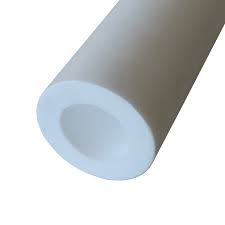
This PTFE plastic tube offers outstanding chemical resistance and low friction performance, making it ideal for demanding industrial and laboratory environments. Manufactured from high-purity polytetrafluoroethylene, it maintains stability across a wide temperature range and provides excellent electrical insulation properties.
Supplied in precision-machined sections, this PTFE tube is available in a selection of larger diameters and wall thicknesses, making it suitable for fluid transfer, insulation sleeves, spacers, and bespoke machined components. Its naturally white, non-contaminating finish makes it particularly suited to applications where cleanliness and inertness are critical.
Product Features
- Available diameters: 80 mm OD x 60 mm ID, 80 mm OD x 70 mm ID, and 100 mm OD x 90 mm ID for different wall thickness requirements.
- Standard length of 1000 mm, ideal for cutting to size or machining into custom components.
- Manufactured from high-quality PTFE for exceptional chemical resistance and low surface energy.
- White, opaque finish for easy visual inspection and suitability in clean environments.
- Excellent electrical insulation properties suitable for high-performance wiring and cable management applications.
- Wide operating temperature range, suitable for many high and low temperature processes.
- Rigid tube format for use as sleeves, bushes, spacers, and structural components.
Key Features and Benefits
- Outstanding chemical inertness ensures compatibility with a wide range of aggressive chemicals, solvents, and process media, reducing risk of corrosion and contamination.
- Very low coefficient of friction helps minimise wear and sticking, improving performance in sliding or rotating assemblies.
- Stable over a broad temperature range, helping maintain dimensional integrity and reliability in both hot and cold service conditions.
- Excellent electrical insulating properties make it suitable for high-voltage or sensitive electronic applications where safety and performance are critical.
- Non-stick, easy-to-clean surface supports hygienic operation in laboratories, food-related areas, and other clean environments.
- Can be easily cut and machined, allowing the tube to be customised for bespoke seals, bushes, and technical components.
Specifications
| Specification | Detail |
|---|---|
| Material | PTFE (polytetrafluoroethylene) |
| Available diameters (OD x ID) | 80 mm x 60 mm; 80 mm x 70 mm; 100 mm x 90 mm |
| Colour | White, opaque |
| Standard length | 1000 mm |
| Form | Rigid tubular section, suitable for cutting and machining |
| Typical applications | Insulation sleeves, fluid transfer linings, bushes, spacers, and machined parts |
Applications and Ideal Uses
This PTFE tube range is designed for technical and industrial settings where chemical resistance, electrical insulation, and dimensional stability are paramount.
- Laboratory and chemical processing lines carrying aggressive or highly reactive media.
- Electrical insulation sleeves and cable protection in high-voltage or sensitive equipment.
- Machined bushes, spacers, and wear parts in mechanical assemblies and jigs.
- Protective linings or guides in fluid handling systems and dosing equipment.
- Cleanroom and pharmaceutical environments requiring low contamination and easy cleaning.
Frequently Asked Questions
Can this PTFE tube be machined into custom components?
Yes, the tube can be cut, drilled, and machined using appropriate tooling to produce custom bushes, spacers, and other precision components. Care should be taken to support the tube during machining to maintain dimensional accuracy.
Is the PTFE tube suitable for use with strong acids and solvents?
The PTFE material offers excellent resistance to most strong acids, alkalis, and organic solvents, making it suitable for many aggressive chemical environments. However, it is advisable to verify compatibility with specific chemicals and operating conditions before use.
Can the tube be used at high temperatures?
PTFE maintains its properties over a wide temperature range and can typically be used in both elevated and low temperature applications. Always confirm your system’s operating temperature against PTFE performance data and apply an appropriate safety margin.
All sizes & prices
3 sizes · prices include VAT · tap a price to select that size
| Size | Price | Ex VAT |
|---|---|---|
| 80mm OD x 60mm ID / White / 1000mm | £833.68 | £694.73 |
| 80mm OD x 70mm ID / White / 1000mm | £544.19 | £453.49 |
| 100mm OD x 90mm ID / White / 1000mm | £724.80 | £604.00 |
Need a size that isn't listed? We cut to order. Request a quote or call 01744 520110.
Supplying UK engineers, manufacturers and public bodies


