



Our Clients
Description
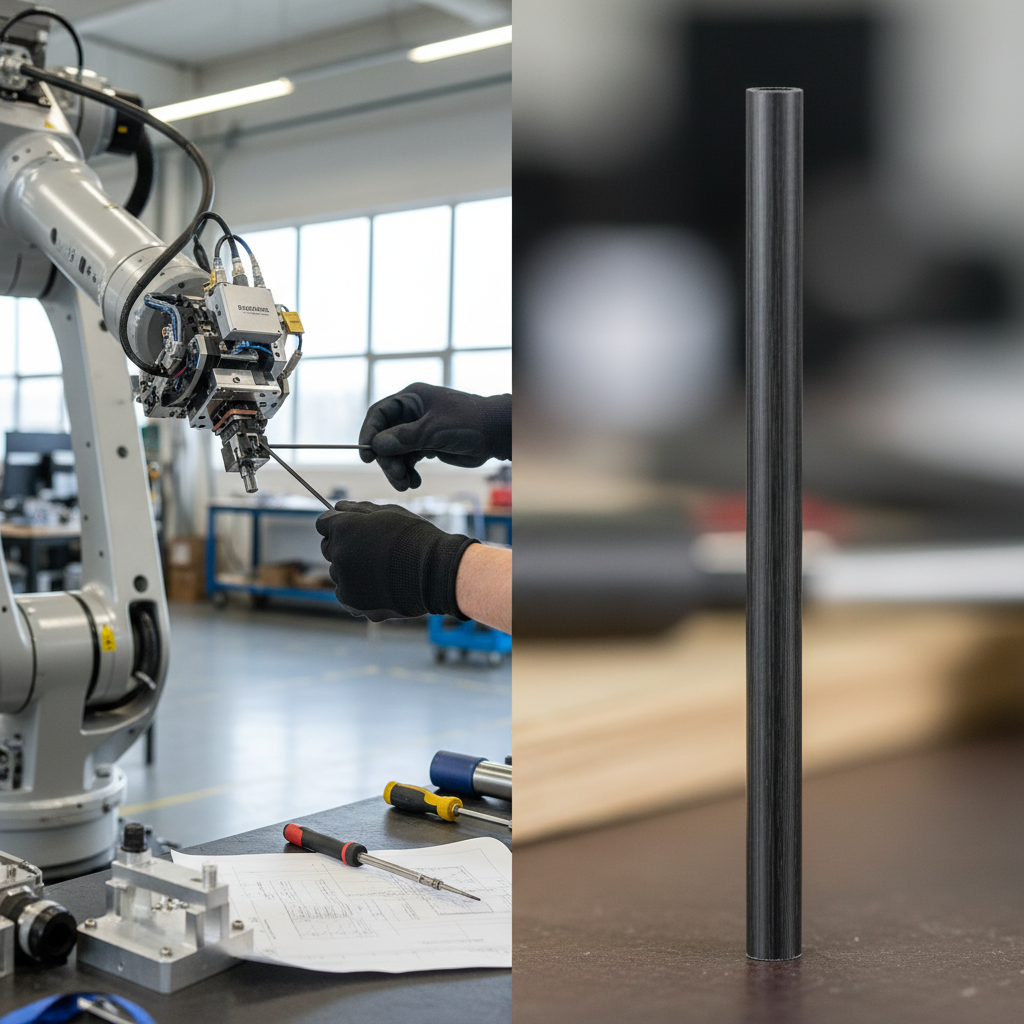
These premium pultruded carbon fibre microtubes are ultra-lightweight, high-strength tubular profiles engineered for demanding precision applications. Manufactured with continuous carbon fibre reinforcement in an epoxy resin matrix, they offer outstanding stiffness and dimensional stability in an exceptionally small form factor.
Ideal for use in precision engineering, robotics, instrumentation and model making, these microtubes are supplied in convenient 1000 mm lengths and a choice of outside diameters and wall thicknesses. They provide an excellent alternative to metal microtubing where weight reduction, corrosion resistance and vibration performance are critical.
Product Features
- Available outside diameters: 0.7 mm and 1.0 mm for ultra-fine, space-saving assemblies.
- Wall thickness options of 0.2 mm and 0.25 mm to balance stiffness and minimal weight.
- Standard 1000 mm tube length for easy cutting and integration into custom designs.
- Pultruded construction with continuous carbon fibre reinforcement for maximum axial strength.
- Epoxy resin matrix providing excellent bonding to compatible adhesives and resins.
- High stiffness-to-weight ratio, significantly lighter than comparable metal microtubes.
- Neat, consistent round profile suitable for precision assemblies and miniature mechanisms.
Key Features and Benefits
- Ultra-lightweight construction helps minimise overall system mass, improving efficiency and response in moving assemblies.
- High tensile strength and stiffness offer reliable performance in loaded or cantilevered components at very small diameters.
- Excellent dimensional stability and straightness support accurate alignment in precision engineering and optical applications.
- Corrosion-resistant material is suitable for use in challenging environments where metal tubing may degrade.
- Easy to cut to length using appropriate fine cutting tools, enabling custom tube sections and prototypes.
- Good compatibility with many structural adhesives allows secure bonding into housings, joints and composite structures.
Specifications
| Specification | Detail |
|---|---|
| Outside diameter options | 0.7 mm, 1.0 mm |
| Wall thickness options | 0.2 mm, 0.25 mm |
| Standard length | 1000 mm (1 metre) |
| Material | Pultruded carbon fibre with epoxy resin matrix |
| Typical colour/finish | Black carbon fibre, smooth pultruded surface |
| Typical use temperature | Dependent on application; generally suitable for many ambient and moderately elevated temperatures |
Applications and Ideal Uses
These carbon fibre microtubes are designed for precision, lightweight structures and mechanisms where small size and high performance are essential.
- Miniature robotic arms, linkages and end effectors.
- Instrumentation, sensors and probe supports in laboratory or test equipment.
- Model engineering, scale aircraft, drones and radio-controlled vehicles.
- Precision mechanical assemblies, guides and alignment pins in compact devices.
- Lightweight frames, struts and reinforcing elements in composite structures.
Frequently Asked Questions
Can these carbon fibre microtubes be cut to shorter lengths?
Yes, the tubes can be cut to size using appropriate fine cutting tools such as a fine-toothed saw or abrasive cutting wheel. It is recommended to support the tube during cutting and use tape around the cut line to help minimise splintering, then carefully deburr the ends if required.
Are these microtubes suitable for bonding and joining with adhesives?
These microtubes are manufactured with an epoxy resin matrix, which is generally compatible with many structural and engineering adhesives. For best results, lightly abrade and degrease the bonding area and follow the adhesive manufacturer’s surface preparation and curing guidelines.
Can the tubes be used outdoors or in humid environments?
The carbon fibre and epoxy construction offers good resistance to moisture and corrosion, making the tubes suitable for many outdoor or humid applications. However, long-term performance will depend on the specific environment and loading, so it is advisable to test under representative conditions where critical performance is required.