



Our Clients
Description
This premium light grey PVC-C rod is a high-performance engineering plastic designed for demanding industrial environments. Offering an excellent combination of chemical resistance, mechanical strength and dimensional stability, it is ideal for machined components that must perform reliably under challenging conditions.
Available in a wide range of diameters and in practical 1000 mm and 2000 mm lengths, this PVC-C rod is widely used for fabricating custom parts in chemical processing, fluid handling systems, electrical equipment and general industrial machinery. Its light grey colour gives a clean, professional appearance while assisting with easy visual inspection in process areas.
Product Features
- Material: Rigid PVC-C (chlorinated PVC) engineering plastic rod in light grey.
- Diameters available from 15 mm to 40 mm as standard, plus 10 additional diameter options for precise sizing.
- Supplied in convenient 1000 mm and 2000 mm standard lengths to suit different machining and installation needs.
- High mechanical strength and rigidity suitable for precision-machined parts and structural components.
- Excellent resistance to many acids, alkalis, salts and industrial chemicals.
- Good dimensional stability with low moisture absorption for consistent performance in service.
- Smooth, uniform surface finish ideal for turning, milling, drilling and other common machining processes.
Key Features and Benefits
- Outstanding chemical resistance helps extend component life in environments exposed to aggressive media, reducing maintenance and downtime.
- High strength and stiffness provide reliable performance where structural integrity and wear resistance are essential.
- Easy to machine with standard metalworking tools, enabling efficient production of bespoke parts, prototypes and replacements.
- Wide choice of diameters and lengths minimises waste and allows closer matching to finished component sizes.
- Light grey colour offers a clean, technical appearance and supports visual inspection of contamination or wear.
- Good electrical insulating properties make it suitable for use in electrical and instrumentation applications where insulation and robustness are required.
Specifications
| Specification | Detail |
|---|---|
| Material | PVC-C (chlorinated polyvinyl chloride) rigid engineering plastic |
| Colour | Light grey |
| Available diameters (mm) | 15, 20, 25, 30, 40 mm plus 10 additional diameter options |
| Standard lengths (mm) | 1000 mm and 2000 mm |
| Chemical resistance | Resistant to many acids, alkalis, salts and industrial cleaning agents |
| Typical applications | Machined components, fittings, supports, insulating parts and fluid handling elements |
Applications and Ideal Uses
This PVC-C rod is suited to a broad range of industrial and engineering applications where chemical resistance, mechanical strength and reliable insulation are required.
- Machining custom components for chemical processing and dosing equipment.
- Fabrication of supports, spacers and bushes in industrial machinery and plant.
- Production of insulating parts, terminal blocks and housings in electrical and control systems.
- Manufacture of fittings, manifolds and brackets for fluid handling and water treatment installations.
- General maintenance, repair and overhaul tasks requiring durable, chemically resistant plastic stock.
Frequently Asked Questions
Can this PVC-C rod be machined using standard workshop equipment?
Yes, the rod can be machined with standard metalworking tools such as lathes, mills and drills. Sharp tooling and appropriate cutting speeds are recommended to achieve a smooth finish and maintain dimensional accuracy.
Is the PVC-C rod suitable for use in contact with strong chemicals?
The PVC-C material offers very good resistance to many acids, alkalis and salts, making it suitable for a wide range of chemically aggressive environments. However, compatibility should always be checked against specific chemicals, concentrations and operating temperatures before use.
Can I cut the rod to shorter lengths on site?
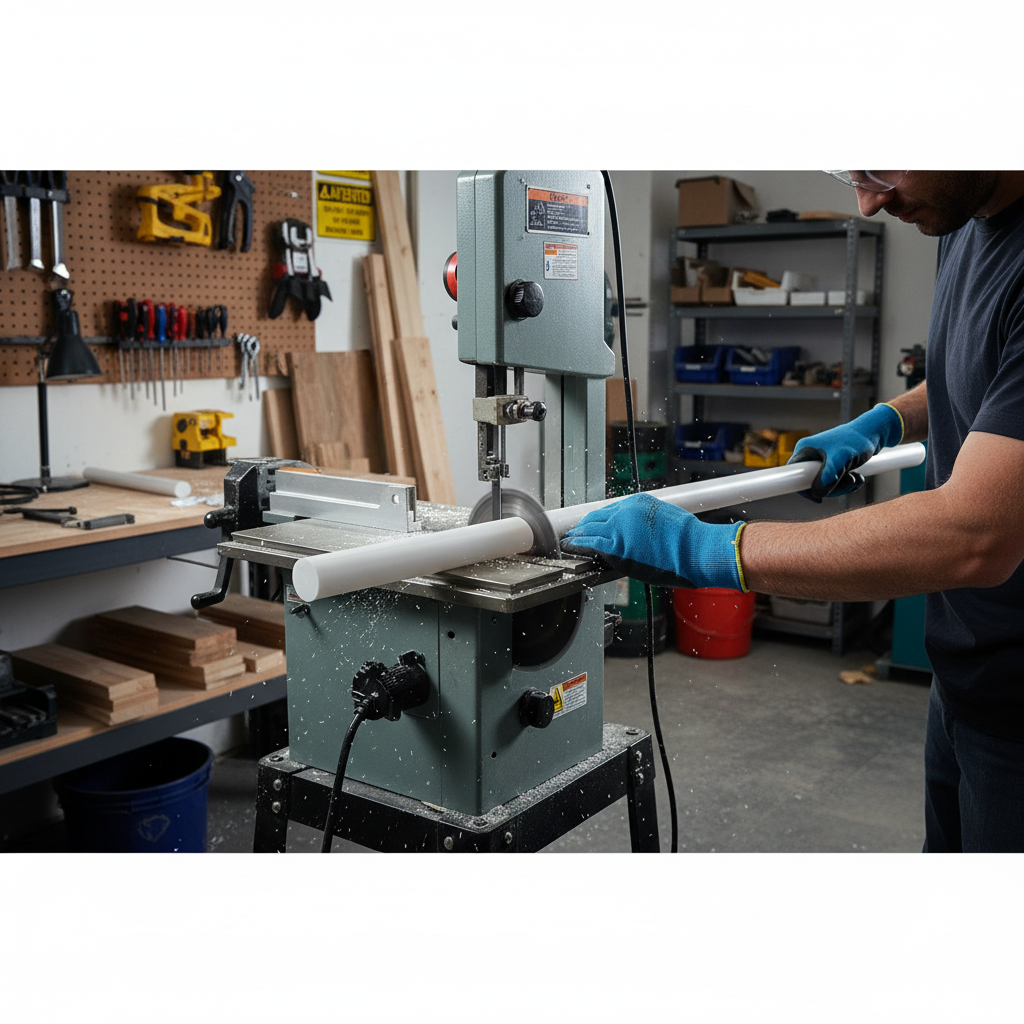
Yes, the rod can be cut to size using appropriate saws or cutting equipment. Ensure the rod is properly supported during cutting and remove any burrs from cut edges to prepare it for further machining or installation.