

Our Clients
Description
Solid polycarbonate sheet — the strongest transparent glazing material available, rated 250 times the impact resistance of glass and virtually unbreakable under normal conditions. Cut to your exact dimensions or supplied in standard sheet sizes. Available in 2mm, 3mm, 4mm, 5mm, 6mm, 8mm, 10mm and 12mm thicknesses to cover every application from lightweight display panels to heavy-duty industrial machine guards and anti-vandal glazing. UV-stabilised surface protection as standard. Free UK delivery on qualifying orders, same-day dispatch on in-stock sizes.
Full Technical Specification
| Material | Solid polycarbonate (PC) | Impact Resistance | ~250× stronger than glass |
| Thickness Range | 2mm, 3mm, 4mm, 5mm, 6mm, 8mm, 10mm, 12mm | Colours | Clear, Opal (Frosted White) |
| UV Protection | UV-stabilised surface — suitable for external use | Operating Temperature | -40°C to +120°C |
| Light Transmission (Clear) | Approx. 88–90% | Density | 1.2 g/cm³ |
| Flammability | Self-extinguishing — UL94 V-2 | Thermal Expansion | Allow 3mm per metre per 10°C change |
| Fabrication | Drills, saws, routers — standard plastic-cutting tooling | Surface | Protective film on both faces |
Why Polycarbonate Sheet — Not Glass, Not Acrylic
Polycarbonate occupies a unique position in the glazing materials hierarchy. Glass is rigid and brittle — it shatters under impact and creates dangerous shards. Acrylic is lighter but fractures under moderate impact and cracks when drilled. Polycarbonate does neither. It absorbs and distributes impact energy across its surface, bending before it breaks, and returning to near-original form under moderate load. At equivalent thickness it transmits comparable light to glass, weighs half as much, and will not shatter into dangerous fragments under any normal loading condition.
For applications where safety, weight and optical clarity are all required simultaneously — machine guards, anti-vandal panels, conservatory roofing, security glazing, display cases, protective barriers — polycarbonate is the only material that satisfies all three requirements.
Thickness Selection Guide
| Thickness | Typical Application | Notes |
|---|---|---|
| 2mm | Display panels, light glazing, picture frame glazing, small windows | Flexible — can be cold-formed to gentle curves |
| 3mm | Internal partitions, light machine guards, greenhouse glazing | Good balance of weight and rigidity for light-duty applications |
| 4mm | Caravan and motorhome windows, machine guards, secondary glazing | Most popular general-purpose thickness |
| 5mm | Security glazing, heavier machine guards, industrial panels | Significant impact resistance increase over 4mm |
| 6mm | Anti-vandal glazing, bus shelters, external barriers, commercial glazing | Specified grade for anti-vandal and commercial security applications |
| 8mm | Riot shields, ballistic-resistant glazing, high-security panels | Professional security specification |
| 10mm | Structural glazing applications, heavy machine guards, blast containment | Engineering-grade specification |
| 12mm | Maximum impact protection — specialist security and industrial use | Heaviest commercially stocked solid polycarbonate sheet |
Where Polycarbonate Sheet Is Used
- ✔ Machine guards and safety guards — the legal requirement in many industrial environments; polycarbonate provides a transparent barrier that meets guarding standards while maintaining visibility of the machinery
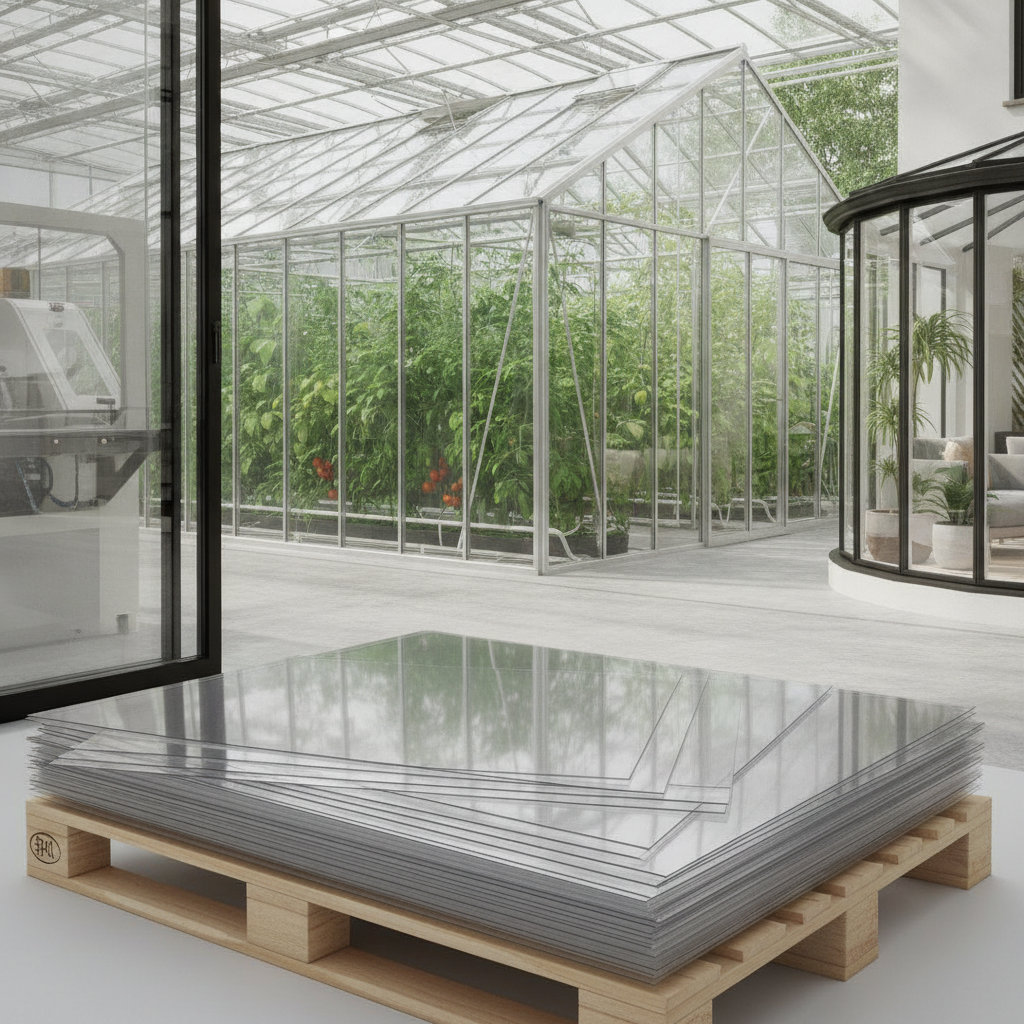
- ✔ Greenhouses and cold frames — lighter than glass, virtually unbreakable, and UV-stabilised for extended outdoor life
- ✔ Anti-vandal glazing — bus shelters, phone boxes, public transport, schools and any environment where glass would be an unacceptable vandalism risk
- ✔ Caravan and motorhome windows — standard glazing material for the leisure vehicle industry; lightweight, impact-resistant, thermally efficient
- ✔ Security screens and barriers — crowd control barriers, retail security screens, bank and post office security glazing
- ✔ Conservatories and roof lights — roofing panels for conservatories, lean-tos and garage skylights where light transmission and weather resistance are required
- ✔ Display cases and retail fixtures — transparent panels for retail displays, museum cases, product protection barriers
- ✔ Signage and point-of-sale displays — clear or opal sheet for illuminated signage and display panels
- ✔ Aquariums and water features — watertight panels for custom aquarium builds and decorative water feature installations
Clear vs Opal — Which to Choose
Clear polycarbonate transmits approximately 88–90% of visible light — comparable to standard float glass. The surface has a very slight blue-green tint when viewed edge-on, which disappears in use. Clear is the specification for applications where visual transparency is required: machine guards, security glazing, windows, display cases.
Opal polycarbonate (frosted white) diffuses light evenly, eliminating glare and hot spots while maintaining good light transmission. The choice for signage backing panels, office partitions where privacy is required, light boxes and applications where light diffusion is more important than transparency.
Working With Polycarbonate Sheet
Cutting
Polycarbonate cuts cleanly with standard woodworking tools. Use a fine-toothed saw blade for straight cuts, a jigsaw for curves. Allow the blade to do the work — slow feed speed prevents melting. Score-and-snap works for thinner sheets (2–3mm).
Drilling
Important: polycarbonate is notch-sensitive — a sharp notch or crack at a hole edge significantly reduces the impact resistance in that area. Always use a sharp bit, drill at slow speed, use a backing board to prevent break-out on exit, and oversize holes by 2–3mm per metre to accommodate thermal expansion.
Thermal Expansion
Polycarbonate expands and contracts more than glass. Allow 3mm per metre of sheet length per 10°C temperature differential. A sheet installed in winter that will experience 40°C temperature rise in summer needs 12mm of expansion clearance per metre. Failure to allow for expansion will cause buckling.
Fixing
Use slotted holes (not circular) at fixing points to allow thermal movement. Gaskets or neoprene washers under fixings prevent point loading. Never clamp the sheet tightly — it must be free to move.
Cleaning
Clean with warm water and a mild detergent — not solvents, acetone, or abrasive cleaners, which will attack the surface. Remove the protective film before cleaning.
Delivery & Returns
Free UK mainland delivery on all orders. Standard sheets are carefully packed and palletised for safe transit. Cut-to-size orders are produced to your exact specification. 14-day returns on unused, undamaged standard-size sheets.
Frequently Asked Questions
Is polycarbonate the same as Perspex?
No — Perspex is a brand name for acrylic (PMMA), which is a different material. Acrylic is harder, clearer and more scratch-resistant but significantly more brittle than polycarbonate. Polycarbonate is the correct choice where impact resistance matters; acrylic where clarity and scratch resistance are the priority.
Can polycarbonate be used externally?
Yes — UV-stabilised grades (standard in our range) are fully suitable for external use. The UV-stabilised surface prevents yellowing and degradation from UV exposure that affects non-stabilised grades.
How do I prevent scratching?
Keep the protective film on until final installation. Clean only with soft cloths and mild soapy water — never dry wipe, never use solvent cleaners. For scratch-resistant applications, specify Marguard or hard-coated grade.
What size sheets do you supply?
We supply standard sheet sizes (250mm × 500mm through to 1250mm × 2500mm) in all thicknesses. Custom cut-to-size is available — contact us for a quotation on non-standard dimensions.
Do you supply in bulk for trade?
Yes — trade accounts, contractor pricing and volume discounts are available. Contact us for a trade quotation.